
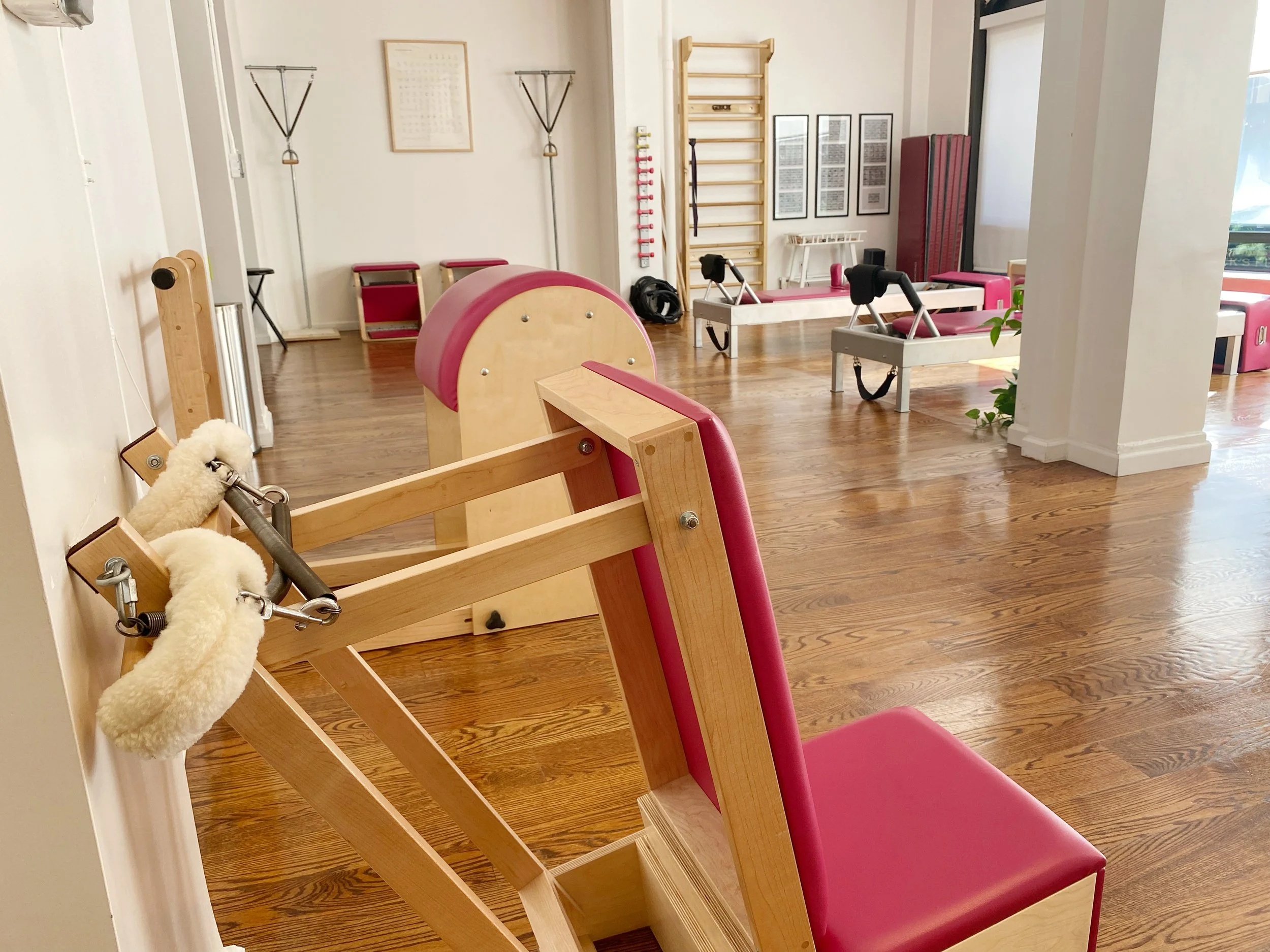
Most people look at a Reformer and see a sliding carriage. The part that actually does the teaching is the springs.
Think of springs the way you would think of a conversation partner. A weight just sits there and says, "lift me." A spring responds. It pulls back, it gives, it follows you, and it tells you immediately whether you are moving with control or letting momentum take over. That responsiveness is what makes springs one of the most important ideas in the method.
Historical context
Springs were part of Joseph Pilates' thinking from early on. During World War I, while interned in England, he began working out his system for fellow internees, including early spring-based rehabilitation equipment fashioned from bed springs, so that people who could not get out of bed could still exercise.
When he opened his studio in New York in 1926, springs had become part of a larger design. He was a prolific inventor, and he did not conceive of his apparatus as separate machines. The Reformer, Cadillac, Wunda Chair, Barrels, Spine Corrector and smaller pieces form one integrated system, and springs are a common thread across much of it.
This is also why equipment matters. Gratz Industries was Joseph Pilates' own manufacturer, and Gratz-style apparatus is built to the proportions and spring behavior of his original designs.
Why it matters
Springs provide resistance that responds to you. Unlike a fixed weight, a spring's pull changes through the range of the movement. You feel it differently at the beginning, middle and end of an exercise, which asks you to stay engaged the whole way through.
Springs can assist, not just resist. This is the idea most newcomers miss. Depending on the exercise, the springs may add load, or they may help support the body so you can find alignment and control. In some exercises a lighter setting asks more of you, because you must control the movement without the springs doing part of the work.
Springs reveal habits. Because the carriage moves in response to you, rushing, collapsing or gripping shows up immediately. A good teacher uses that feedback. So does the student.
Springs teach the work. Joseph Pilates named his method Contrology, the study of control. Springs are one of the clearest tools for learning it. You cannot muscle through an exercise with momentum and expect it to feel right.
An analogy: think of a spring as a good coach standing beside you. Sometimes the coach lifts some of the load so you can learn the movement. Sometimes the coach steps back so you have to do it yourself. The skill is in knowing which one the moment calls for.
[CYNTHIA TO PROVIDE: one concrete example] For instance, an exercise where she changes the spring setting for a particular client, and why. Use her words and get her approval before attributing. Do not publish specific spring numbers unless she confirms them.
Common misunderstanding
"More springs means a harder workout." Not necessarily. A heavier setting makes some exercises harder, makes others easier, and can change what an exercise is actually training. Choosing springs is not a dial from easy to hard. It is a decision about what the exercise is meant to teach and what this body needs today.
A second misunderstanding is that springs are interchangeable from one machine to another. Spring tension, carriage design and frame proportions all affect how an exercise feels. Equipment that departs significantly from the original specifications changes the resistance, the geometry and the experience of the work, while carrying the same name.
How LifeSpan preserves it
LifeSpan Pilates maintains a full set of original-style Gratz apparatus, and we teach in the Romana lineage, where the order of the exercises and the integrated apparatus system are preserved rather than rearranged. Our teachers complete a full apprenticeship, with observation, practice teaching and mentorship, so they learn how to choose and change spring settings for the person in front of them and not by formula.
That judgment, knowing when to add resistance, when to offer support, and when to step back, is a large part of what separates a teacher who knows the shape of the exercises from one who understands the architecture beneath them.
Reflection
A spring is a small, plain piece of equipment. But in the hands of a teacher who understands it, it becomes a way of listening to the body and answering it. That is the point of the apparatus, and it is a good reason to learn the work from people who were taught to see.
Want to feel the difference? Book a private introductory session at LifeSpan Pilates in Midtown Manhattan (33 W. 46th St.).
Related Pilates Roots Articles
Mat vs. Reformer Pilates: Where Should a Beginner Start?
Is Pilates Strength Training? What to Know After 40
Why the Order Matters